Corevia runs the medicine behind healthcare brands — a 1,800-physician network, a FHIR-native EMR, ambient AI documentation, e-prescribing and 503A compounding, across asynchronous review, video visits and your own clinic rooms. Your storefront, your merchant account, your brand. Our clinical rails.
Weight management · hormone therapy · peptides · longevity · sexual health · dermatology
Running under a Business Associate Agreement. See our security posture →
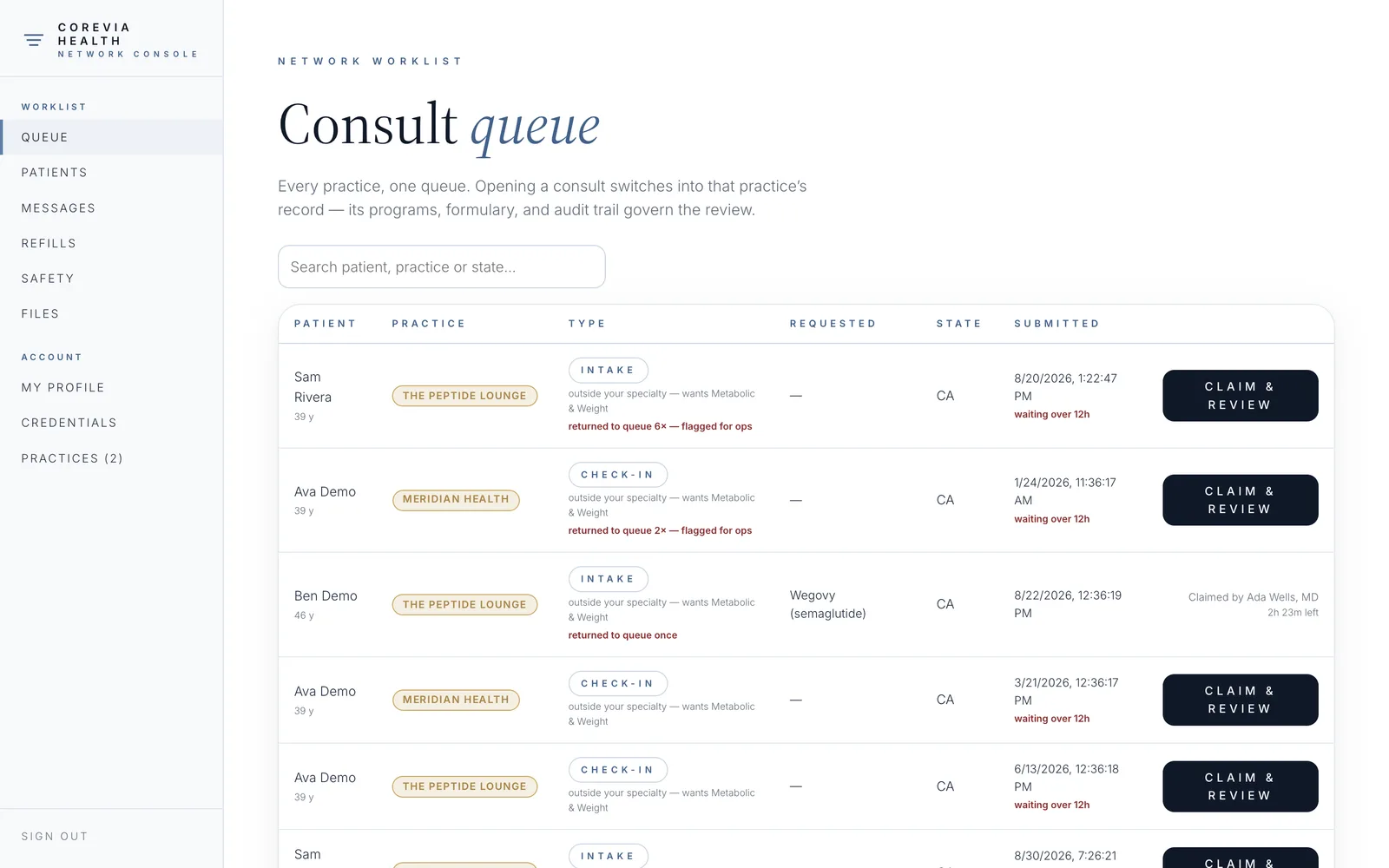
The hardest part of this category to build is not the EMR — it is routing one physician's attention across many brands without letting those brands bleed into each other. This is that screen, in the working product.

Patients, clinicians, your operations team and the physician network all work against the same FHIR-native chart and the same audit trail. Nothing is stitched together after the fact.
Charting, problem lists, medications, allergies, vitals, labs and documents on a standards-based record — interoperable by construction, not by export.
CoreVisit audio becomes a structured SOAP note the clinician reviews and signs — inside our own cloud boundary, with no third-party scribe vendor.
In-account AIChart-aware summarization, drafting and recall at the point of care. Grounded in the patient's own record, always attributed, never the decision-maker.
In-account AIThreaded, in-portal, routed to the responsible clinician, written to the chart as a clinical communication — and escalated if it goes unanswered.
SecureNative synchronous visits with a branded waiting room, and automatic escalation when a program or state requires a live encounter.
SynchronousRouted to retail and compounding pharmacies with formulary awareness, refill management and controlled-substance workflows.
e-Rx30+ partners integrated for fulfillment, with per-brand formulary control, shipping visibility and state-level dispensing rules.
FulfillmentOrder sets, requisitions and structured results flowing back into the chart — with trending, abnormal-value flagging and provider notification.
DiagnosticsCheckout, subscriptions and revenue splits through your merchant account. We never sit in the funds flow and never take a percentage of GMV.
Bring your ownClinic locations, in-person booking and provider availability alongside async review and video — one patient record whichever way the visit happens.
HYBRIDPrograms are configuration, not code — define intake, protocol, formulary, pricing and required verification depth, then launch under any brand you operate. See how configuration works →
Most white-label platforms assemble a network, an EMR and a fulfillment partner and present the seams as a product. The differences below are architectural, and they show up in diligence.
| Capability | Corevia | Typical white-label platform |
|---|---|---|
| Consult routing | Aggregated queue across every brand, sync and async together, license-enforced server-side | Per-brand worklists; modality split across tools; licensure by policy |
| Clinical record | FHIR-native EMR with an open R4 API — portable by design | Proprietary schema; export on request |
| Where AI runs | Inside our own cloud account under BAA — no third-party model vendor receives PHI | "AI-powered", vendor and data path unstated |
| Payments | Your merchant account, you are merchant of record, no percentage of GMV | Platform sits in the funds flow and takes a cut |
| Configuration | Programs, consents, intake and check-in forms edited by your team, versioned, live without a release | Change requests through an account manager |
| Tenant isolation | Separate clinical project and access policies per brand, enforced at the data layer | Shared tables with an application-level brand filter |
| Own clinicians | Run your employed physicians and the network together in one practice | Network only, or your clinicians in a separate system |
| Compounding | 30+ 503A partners with per-brand formulary and state dispensing rules | Single fulfillment partner, limited formulary control |
| Insurance billing | Not offered — cash-pay and DTC by design | Payer contracts and RCM available |
On insurance, deliberately: Corevia is built for cash-pay and direct-to-consumer medicine. No payer contracts, no claims denials and no RCM cycle shaping your clinical model or your cash flow. If your business depends on billing insurance, we are the wrong platform and will tell you so on the first call.
Corevia runs in a dedicated cloud environment under a Business Associate Agreement, deployed on SOC 2 Type 2 and HITRUST-certified infrastructure, with HIPAA and HITECH safeguards implemented at the data layer rather than in policy documents.
Every brand is a separate clinical project with its own access policies — isolation enforced by the data layer, not by a filter in application code.
AI documentation and clinical assistance run inside our own cloud account under BAA. No patient data is sent to third-party model providers.
Every PHI view, edit, message and prescription is recorded and attributed to a named clinician, with audit events no role may alter or delete.
Pick your programs, protocols, formulary and pricing. We configure the storefront, intake and consent stack under your brand and your domain.
Link your merchant account, choose network coverage or bring your own physicians, and select compounding and diagnostics partners for your states.
Patients enroll, consults route, clinicians prescribe and fulfillment ships — while you manage programs, pricing and roster yourself from the console.
Go to market on a compliant clinical stack instead of assembling six vendors and hoping they agree with each other.
Replace a patchwork of EMR, staffing, e-Rx and fulfillment contracts with one platform and one accountable partner.
Keep seeing patients in your rooms, and extend your own physicians with network coverage for after-hours, overflow and states you are not licensed in.
Add a prescribing arm to an existing customer base — online, in your locations, or both — without building a clinical organization from scratch.
The clinical infrastructure behind a healthcare brand: a national physician network, a FHIR-native EMR, patient portal and intake, telehealth video, encrypted messaging, ambient AI documentation, Surescripts-certified e-prescribing, lab integrations, 503A compounding fulfillment and an operations console — all white-labeled under your brand.
Either, or both in the same practice. Draw on the 1,800-physician Corevia network, run your own employed clinicians, or operate a hybrid where your physicians handle your core panel and the network covers overflow, after-hours and states you are not licensed in.
A marketplace gives you access to clinicians. Corevia routes the work: every consult from every brand, synchronous and asynchronous, lands in one prioritized worklist with licensure, specialty and turnaround enforced by the platform. That orchestration is the product.
You do, and no. You connect your own Stripe account or an existing high-risk merchant account through a supported gateway. You are the merchant of record, settlement goes to your bank, and Corevia never holds funds or takes a share of your revenue.
No. Corevia is built for cash-pay and direct-to-consumer medicine. If your model depends on payer contracts and revenue cycle management, we are not the right platform and we will say so early rather than late.
Inside our own cloud account, under a Business Associate Agreement. Transcription and clinical drafting never leave that boundary, and no third-party model provider receives protected health information. The clinician reviews and signs everything; the AI never makes a clinical decision.
Programs, clinical protocols, formulary, pricing, consent documents, intake questionnaires and check-in forms are all configuration — edited by your team, versioned by the platform, and live on the next patient rather than the next sprint.
Yes. The record is FHIR R4 with an open API — there is no proprietary schema to escape from. We think being easy to leave is what makes staying a decision rather than a trap.
A 30-minute walkthrough of the clinician console, the aggregated consult queue, the AI documentation workflow and the compliance posture behind them.