Physician network

Consult aggregation, not consult staffing.

A roster is a list of names. Corevia routes the work — every consult from every brand, synchronous and asynchronous, into one prioritized worklist, with licensure, specialty and turnaround enforced by the platform rather than by convention.

1,800+ licensed physicians 50 states covered Sync + async one queue, both modalities 12h claim window with escalation
How routing works

The platform decides who may see a patient.

Licensure is not a policy anyone remembers to follow — it's a filter applied on the server before a consult is ever offered, and re-checked when the chart is opened.

State licensure, enforced server-sideA consult only reaches a physician licensed in the patient's state. The routing decision happens before any PHI crosses to a browser, so a withheld patient is not merely hidden — they were never sent.
Expiry stops routing automaticallyLicenses carry expiry dates. The clinician and your ops team are warned in advance; on expiry the platform stops routing without anyone needing to intervene.
Specialty routingPrograms declare the specialty they need. Consults sort toward clinicians who match, and an off-specialty row is labeled rather than silently mixed in.
Modality rulesWhere a program or a state requires a live encounter, the consult routes as a video visit instead of async review — the rule lives in the program definition, not in a clinician's memory.
Oldest first, bounced consults ahead of themPriority is explicit: a consult returned to the queue leads, then the longest wait. Nobody's patient starves because a newer row looked easier.
CONSULT LIFECYCLEIntakeprogram formsVerifyID · age · eligibilityRoutelicense · specialtyReviewsync or asyncFulfille-Rx · 503Adocument + age check50-state license mapAI scribe + assistantIMMUTABLE AUDIT TRAILEvery PHI access, clinical decision and prescription recorded, attributed and append-only
Claims & accountability

One consult at a time, and nothing quietly expires.

Exclusivity and a deadline are what turn a shared queue into accountable work.

Exclusive claim

Taking a consult locks it to that clinician. Two physicians can never both believe they hold the same patient — the server settles the race, not the browser.

One at a time, across every practice

The limit counts claims in every practice the clinician is rostered in, not just the ones currently visible — so a consult held in a filtered view still counts.

A countdown, then escalation

Claims carry a twelve-hour window with warnings before it lapses. An expired claim returns the consult to the queue at the front, with the bounce recorded.

Bounces are visible

A consult returned repeatedly is flagged to operations rather than circulating forever. Repeat bounces are a routing problem, and the platform says so.

Every action attributed

Claim, review, disposition and prescription are recorded against a named, licensed clinician — never against a service account.

Coverage you can see

Capacity by state and program is reported before it becomes a wait time, so marketing spend and clinical supply can be planned against each other.
Your clinicians, ours, or both

A practice and a network in the same brand.

Your employed physicians are colleagues in one practice — they cover for each other and see each other's patients, as a practice should. Network physicians are outside clinicians, entitled only to the patients they have a relationship with. Both work the same brand, and the platform knows the difference.

Practice model

Your own clinicians only. They share a panel and cover for one another, exactly as colleagues in one medical group do.

Network model

Corevia's physicians serve your patients under your brand, scoped to the patients each one is responsible for.

Hybrid

Both at once. Your physicians hold the core panel; the network absorbs overflow, after-hours and the states you aren't licensed in — one queue, one brand.

Different access, deliberately

Practice staff and network clinicians hold different access policies in the same tenant. That distinction is enforced by the data layer, not by a setting someone can forget.

Consult aggregation

Every practice, one queue.

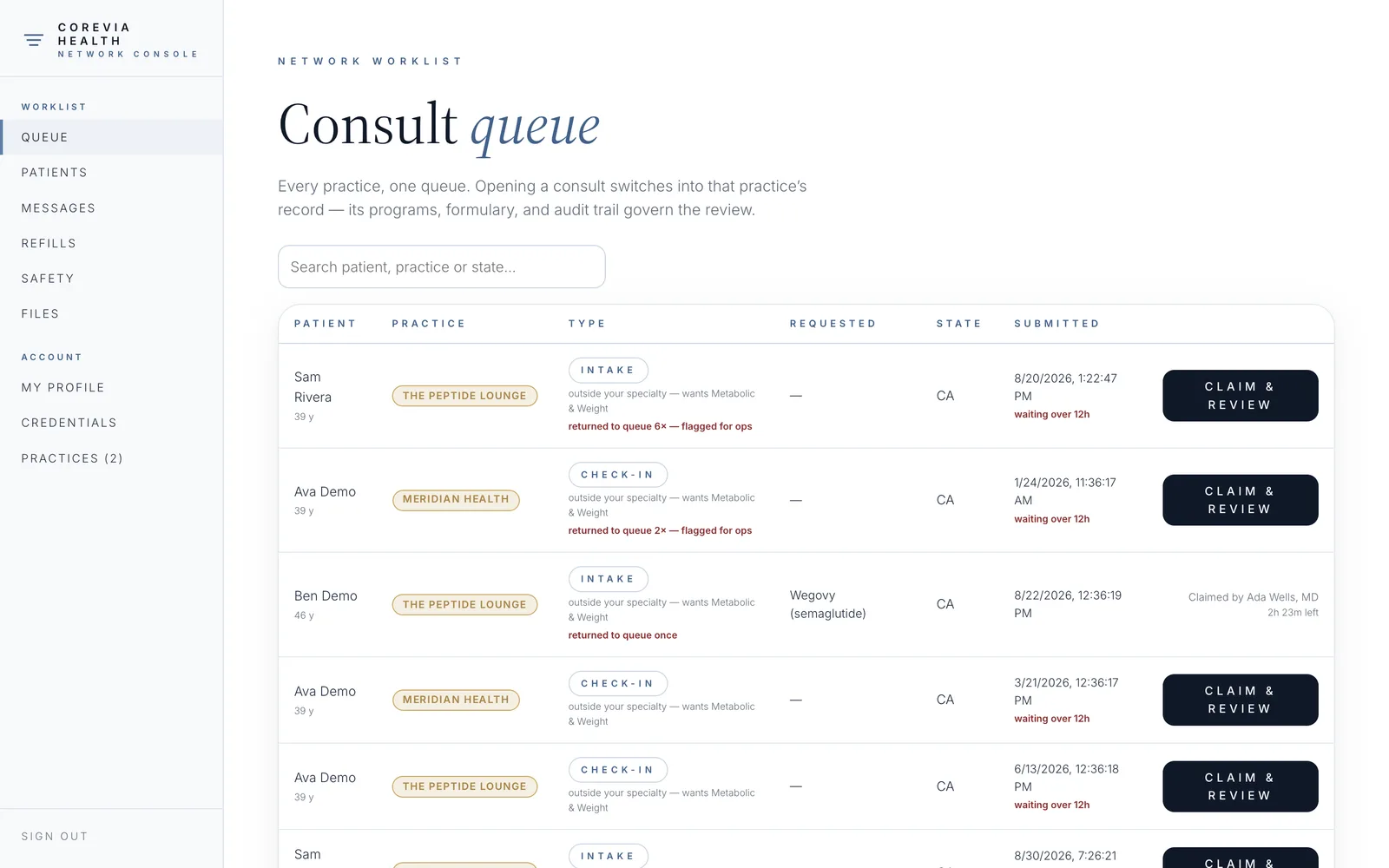
A network physician sees one worklist spanning every practice they are credentialed in. Opening a consult switches into that practice's record — its programs, its formulary, its audit trail — so the aggregation never blurs the boundary between tenants.

network.coreviahealth.com/queue
Network consult queue spanning multiple practices, each row tagged with its practice, state and waiting time
Each row carries the practice it belongs to, the state, and how long it has been waiting — anything overdue is flagged for operations. Demo environment; synthetic data and illustrative practice names.
Keep going

The rest of the platform

See a consult route in real time.

We'll show a patient in a state you name, and watch the platform decide who may see them.