Corevia does not. A patient can be reviewed asynchronously on Monday, seen on video on Thursday and walk into your clinic the following week — and it is one record, one program, one medication history and one audit trail the entire time. If you already have locations, you do not have to run them on a separate system and reconcile the two.
Running virtual care on one platform and the clinic on another is not merely inconvenient. It is the specific arrangement that produces the failures nobody plans for.
The clinician in the room cannot see what was prescribed online last month, and the asynchronous reviewer cannot see what was given in the clinic. Interaction checking is only as good as the list it runs against.
A consent signed in one system does not govern an encounter in the other. Neither does an identity check, a state eligibility rule, or a program's contraindication screen.
When a regulator or a plaintiff's attorney asks for the complete record of a patient's care, "it is in two systems and we exported both" is a materially worse answer than handing over one file.
Same login, same brand, same record. The booking flow knows which programs a given location actually offers, so a patient cannot book a visit the clinic is not set up to deliver.
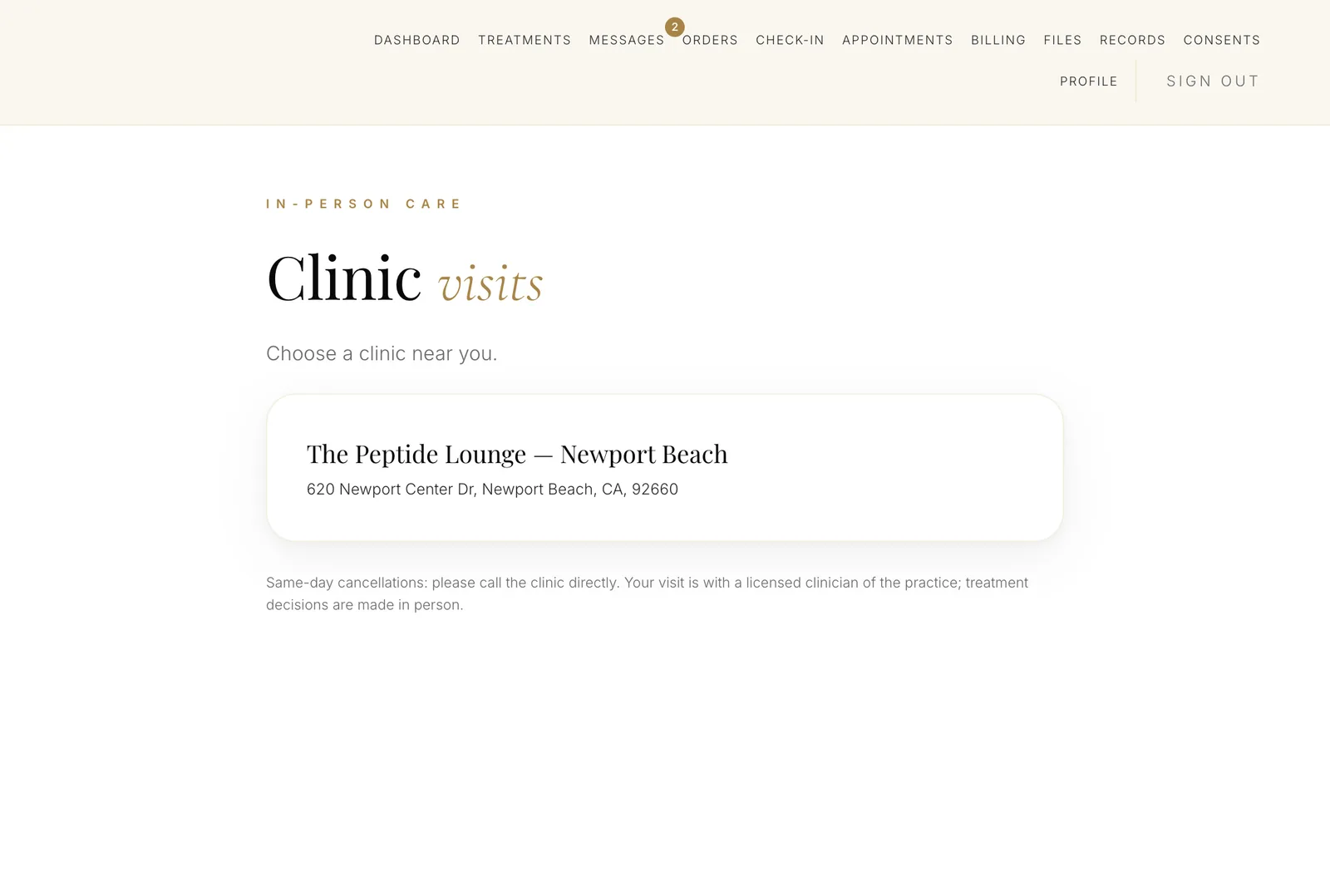
It is not a calendar entry bolted onto a telehealth record. The visit produces a note, orders and a disposition in the same chart the asynchronous reviewer reads.
The patient is told so at the point of booking. Corevia does not practice medicine in a clinic any more than it does on a screen.
Where a state or a program requires a face-to-face encounter before prescribing, and you have a location in that state, the platform can route to it rather than dead-ending the patient.
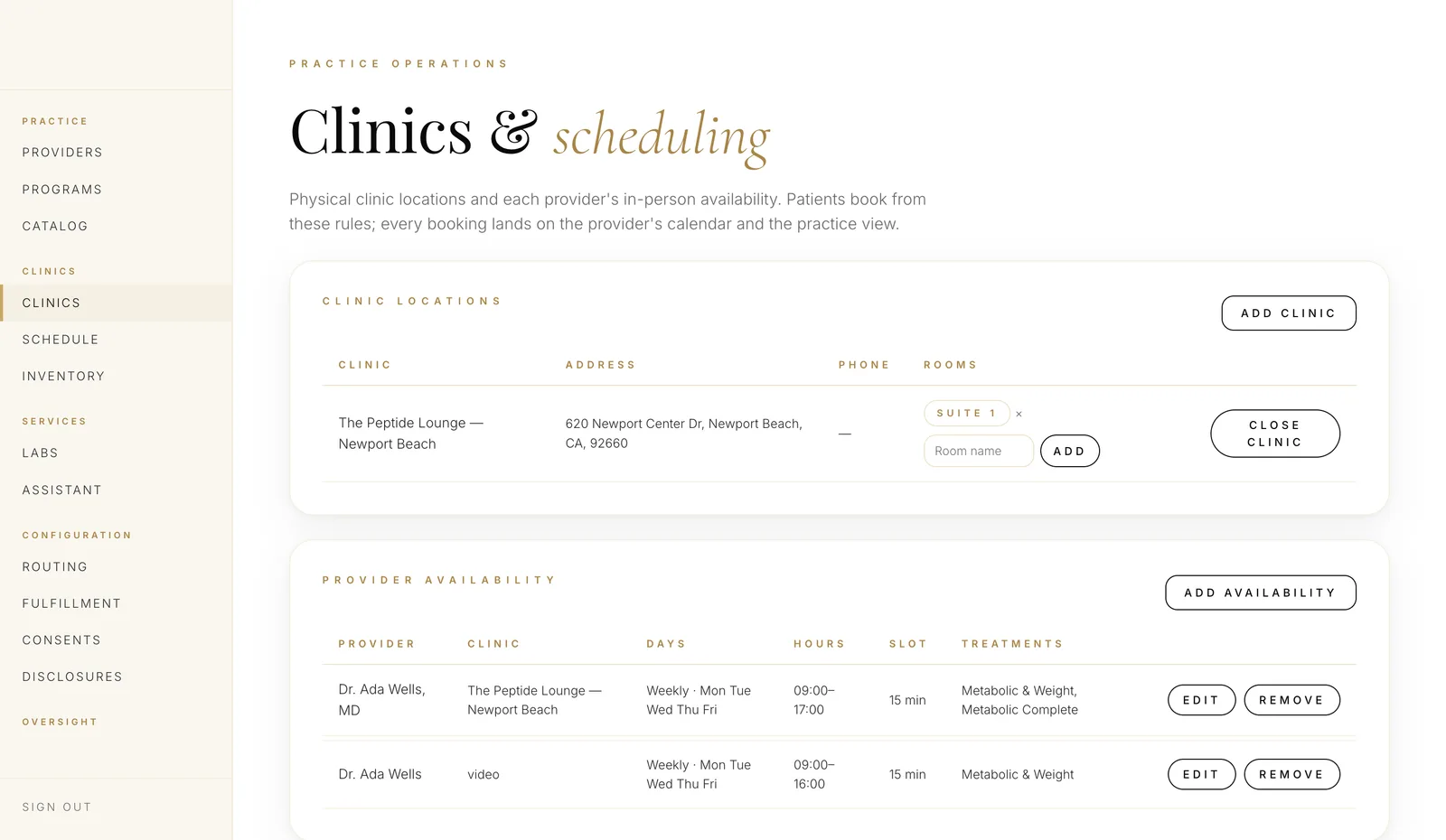
Clinics are configured in the same console as programs, consents and routing — not in a separate scheduling product that has to be kept in sync with the clinical one.

Name, address, phone and opening hours, per location, edited by your operations team without a support ticket. A clinic can be closed without deleting its history.
Who is available, where, and when — with in-person availability and video hours held separately, because they are not interchangeable.
A clinician sees their in-person sessions and their video hours in a single view, so double-booking across modalities is not something anyone has to remember to avoid.
Front desk and support staff can book into the same calendar, which is how most clinic appointments are actually made.
You already have locations, staff and a customer base. What you lack is the clinical layer — licensed prescribers, consents, eligibility, a real record — and a way to run it alongside the treatments you already sell in the room.
You have the room and the clinicians. Asynchronous follow-up, refills and check-ins between visits are what you are missing, and they should land in the chart you already use rather than a parallel one.
Growth eventually runs into states that require a face-to-face encounter, and into patients who want one. Opening a location should not mean adopting a second platform and reconciling two records for the same person.
If you are running rooms and screens on two systems today, the useful part of the first call is looking at how the reconciliation currently works.